The short answer
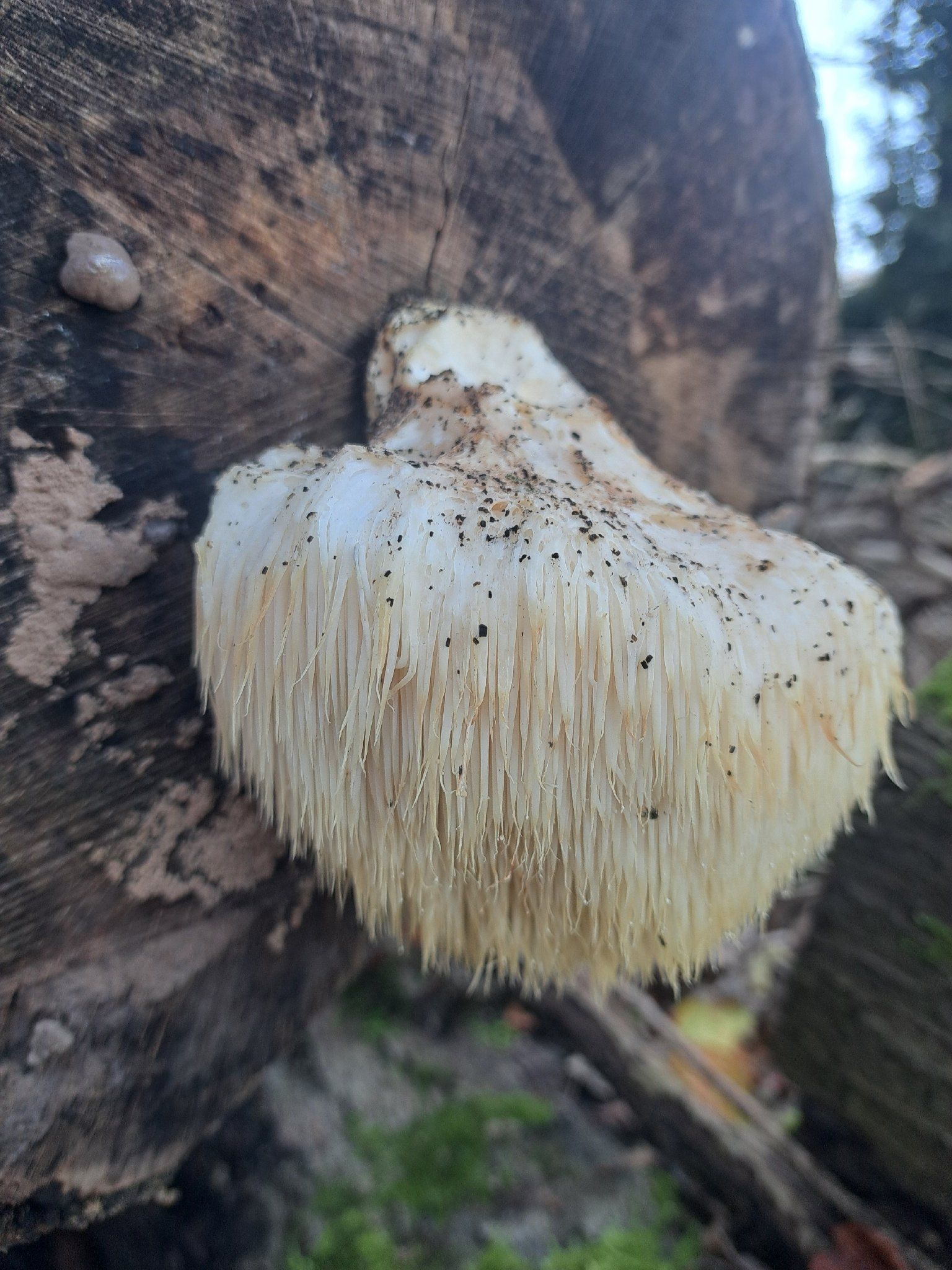
Lion's mane (Hericium erinaceus) is an edible fungus that grows on dying beech, oak and other hardwoods. It looks like a white cushion of hanging spines. It contains two families of compounds, hericenones and erinacines, that stimulate nerve growth in lab studies, which is why it is sold as a brain supplement.
On this page
What does lion’s mane look like?
Lion’s mane is a single white or cream lump, usually 10 to 25 cm across, covered in soft spines 1 to 5 cm long that hang straight down. It has no cap, stem or gills. As it ages it yellows and then browns, and the spines get longer.
It grows from wounds and dead wood on broadleaf trees, most often beech and oak, and usually in autumn. In Britain it is rare in the wild, which is why it is legally protected (see picking it wild). Everything sold in UK shops is grown on farms.
What is in lion’s mane?
Like other mushrooms, it is mostly water, fibre and protein, with a good share of beta-glucans, the fibre-like sugars found in most fungi. What sets it apart are two groups of compounds that researchers have studied since the 1990s:
- Hericenones, found mainly in the fruiting body (the mushroom you can see).
- Erinacines, found mainly in the mycelium (the root-like threads that grow through the wood or growing medium).
In cell and animal studies, both groups make nerve cells produce more nerve growth factor (NGF), a protein that helps nerve cells grow and survive. Some erinacines also cross the blood–brain barrier in animals. These findings are the reason lion’s mane is marketed for memory, focus and nerve repair.
The catch is that lab results do not tell you what a capsule does in a person. The human trials are few and small, and their results are mixed. Our benefits guide grades each claim.
How is it used?
Lion’s mane is eaten as a food in East Asia and has a long history in traditional Chinese medicine, mainly for the stomach. Today it is sold in four main forms:
| Form | What it is | Notes |
|---|---|---|
| Fresh or dried mushroom | The whole fruiting body | Cook it; a culinary portion is usually 50 to 100 g fresh |
| Powder | Dried, ground fruiting body or mycelium | Most trials used fruiting body powder |
| Extract | Powder soaked in hot water or alcohol, then concentrated | Labels give a ratio such as 10:1 |
| Mushroom coffee | Instant coffee blended with a small amount of powder or extract | Doses are often far below those used in trials |
Which part of the mushroom a product uses matters more than most labels admit. Our guide to fruiting body and mycelium explains why.
In this section
- Lion's mane fruiting body vs mycelium: which is better?
Fruiting body and mycelium contain different compounds, and many mycelium products are mostly grain. What the difference means when you buy.
- Can you pick lion's mane in the UK? What the law says
Wild lion's mane is protected under the Wildlife and Countryside Act 1981. Why picking or selling it is an offence, and where to get it legally.
Common questions
Is lion's mane a magic mushroom?
No. Lion's mane contains no psilocybin or any other psychedelic compound, and it is legal to buy and eat in the UK. It is an ordinary edible mushroom that some people take as a supplement.
What does lion's mane taste like?
Fresh lion's mane is mild and slightly sweet, and its stringy texture is often compared to crab or lobster when it is fried. Dried powders taste earthier and a little bitter.
Why is it called lion's mane?
Its long, shaggy spines hang down like a mane. Other English names include bearded tooth, hedgehog mushroom and pom pom mushroom. In Japan it is called yamabushitake and in China hou tou gu, meaning monkey head.
References
- Contato AG et al. Lion's Mane Mushroom (Hericium erinaceus): a neuroprotective fungus with antioxidant, anti-inflammatory, and antimicrobial potential. Nutrients, 2025.pubmed.ncbi.nlm.nih.gov
- Szućko-Kociuba I et al. Neurotrophic and neuroprotective effects of Hericium erinaceus. International Journal of Molecular Sciences, 2023.pubmed.ncbi.nlm.nih.gov
- Othman A et al. Hericenones from Hericium erinaceus: a scoping review of structural diversity and health benefits. Chemistry & Biodiversity, 2026.pubmed.ncbi.nlm.nih.gov
- Amen Y et al. Chemistry and bioactivities of erinacines from Hericium fungi. Journal of Natural Medicines, 2026.pubmed.ncbi.nlm.nih.gov
- Wildlife and Countryside Act 1981, Schedule 8 (plants which are protected).legislation.gov.uk
First published 3 November 2026. Spotted an error? Tell us and we'll correct it. Read our editorial policy.